The problem
It's hard to build intuition for language models when the ones you use have billions of parameters. A model small enough to train in seconds makes every step visible: tokens, vectors, probabilities, and updates.
What I did
- Predicted each result in writing before every run, then compared.
- Wrote 355 new teaching passages on tense and agreement, opposites, and spatial relations, without reading the test items.
- Trained two experiments with identical settings: 3,000 steps at a learning rate of 0.001, on a laptop CPU.
- Traced one token all the way through: word to ID to vector to probability to gradient to update.
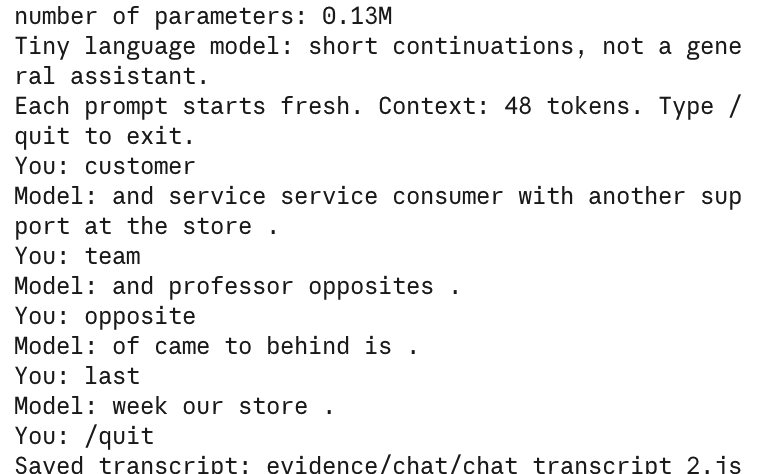
- Built a small chat interface and was clear about what it is: a sentence continuer, not a chatbot.
Results
9 → 20of 48 tests, starter corpus
7 → 25of 48 tests, with my corpus
16/16familiar patterns
14 sto train
What I'd do differently
The model learned templates, not language. And because the public tests guided my choices, a good score doesn't prove it generalizes. Next: write my own held-out test set and never look at it while building the corpus.